

The café that opened down the road last month already has more Google reviews than yours, which has been open for three years. You have a fair idea how. There is a QR code on its counter, a picture of five stars beside it, and a line saying the customer gets something off for leaving a review.
It is tempting to copy it. It is also the one method Google has written a rule against by name, and the cost of being caught falls on the whole listing, not just the reviews that were bought.
What follows is what the quick methods actually are, why an honest review given for a freebie is still against the rules, and how to ask in a way that suits your kind of business so the reviews keep arriving and stay up.
In short
- Offering anything in exchange for a review is forbidden, even when the customer writes an honest one. The incentive is the violation.
- Google also forbids pressuring customers while they are still on the premises, giving staff a review quota, and asking for reviews that name a staff member.
- A listing that is caught can lose its existing reviews for a period, be blocked from new ones, and show customers a warning.
- Asking is allowed. Google gives you a link and a QR code for it, and the right moment to use them depends on what you sell.
Where the fast reviews usually come from
Somebody asked in a Philippine business forum recently how newly opened food places collect so many reviews so quickly, when ordinary customers rarely leave one even after a good meal. The replies were candid, and they describe three methods that many readers will recognise.
The freebie at the counter
One reply described a food stall with a QR code for its Google reviews posted up, a five-star image underneath, and twenty pesos off for every review. Another described a salon that gave a discount the same day, on showing that the review had been posted. A third came from somebody who works at a food business and goes table to table at peak hours, asking diners whether they liked the food and offering a free cookie if they leave a review. That one was the owner’s idea.
The review quota
Another reply pointed to the reviews that keep mentioning the same staff member by name, and said they come from staff being told to collect reviews. Anybody who has read a run of reviews that all thank the same person has seen this without needing it explained.
The paid circle
The bluntest reply worked out the arithmetic of paying relatives, former classmates, co-workers and strangers in Facebook groups twenty to fifty pesos by GCash for five minutes of their time, and concluded that two hundred reviews cost about the same as printing flyers and banners.
What the readers make of it
The person who asked the question said they now distrust any place that opens and has forty reviews almost immediately, and any dental clinic with a great many reviews in the same flat wording posted in the same week. The people you are trying to persuade are doing the same sum.
Why an honest review for a small thank-you is still against the rules
One reply in the same thread defended the freebie: the customer still bought something, the review is honest, and it does not have to be five stars. It is a reasonable-sounding position, and Google’s policy says otherwise.
The incentive is the violation
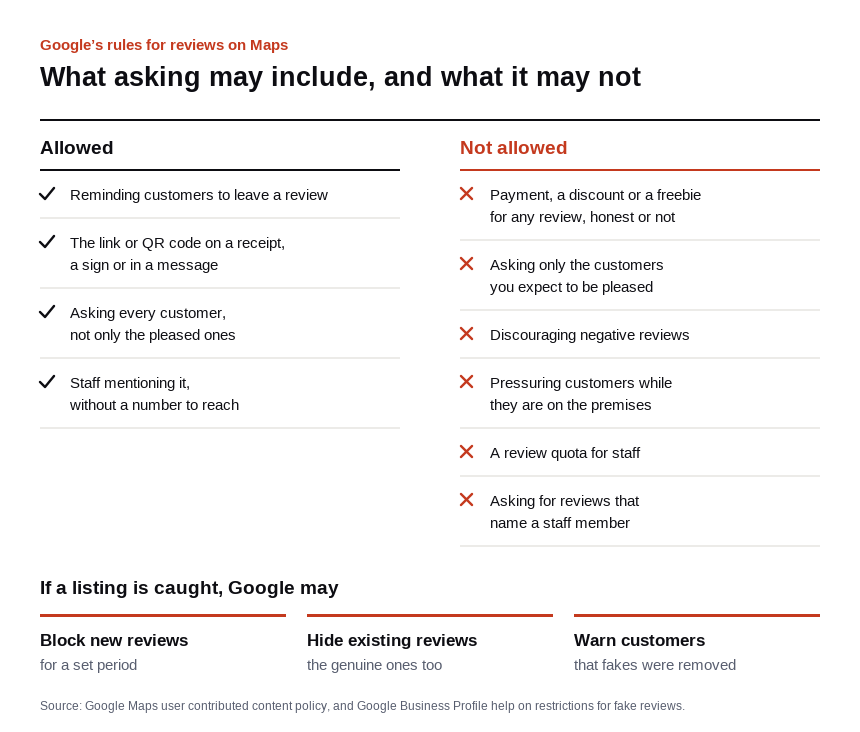
Google’s rules for reviews on Maps forbid a business from offering incentives such as payment, discounts, or free goods or services in exchange for posting any review. They do not say any positive review. The twenty pesos off, the free cookie and the same-day discount are all the same thing in Google’s terms, whatever the customer writes, and reviews posted because of them are treated as rating manipulation and removed.
The same rules also forbid asking only the customers you expect to be pleased, and discouraging negative reviews, and they allow asking only without any attempt to influence the rating. A sign that offers something next to a picture of five stars breaks more than one of them at once.
The rules about the premises and about staff
The part fewer owners know concerns how the asking happens. Google says a business should not require or pressure customers to leave ratings or write reviews while they are on the premises, and should not ask for particular content to be included. It then names two practices directly:
- Review quotas. A business asking its staff to collect a certain number of reviews.
- Named staff. A business asking staff to collect reviews that include specific content, including content that identifies a staff member.
So the reviews that all thank the same server are not only unconvincing to readers. They are a pattern the policy describes by name.
What happens to a listing that is caught
Removing the reviews is not the end of it. Google lists restrictions it may place on a Business Profile when it finds that the owner broke these rules:
- No new reviews or ratings for a set period.
- Existing reviews unpublished for a set period, the genuine ones as well as the bought ones.
- A warning shown to customers that fake reviews were removed from the profile.
Google notifies the owner by email before it applies a restriction, and the decision can be appealed. None of that helps during the weeks the profile shows a warning to every person deciding whether to come in.
Genuine reviews can go with them
Google also removes reviews it identifies as spam automatically, and it says plainly that the system occasionally removes legitimate ones as well. Its policy lists unusual volumes or patterns of reviews as a sign of rating manipulation, and a burst in one week, or a run that all name one employee, is exactly that. Reviews that arrive a few at a time from ordinary customers are not.
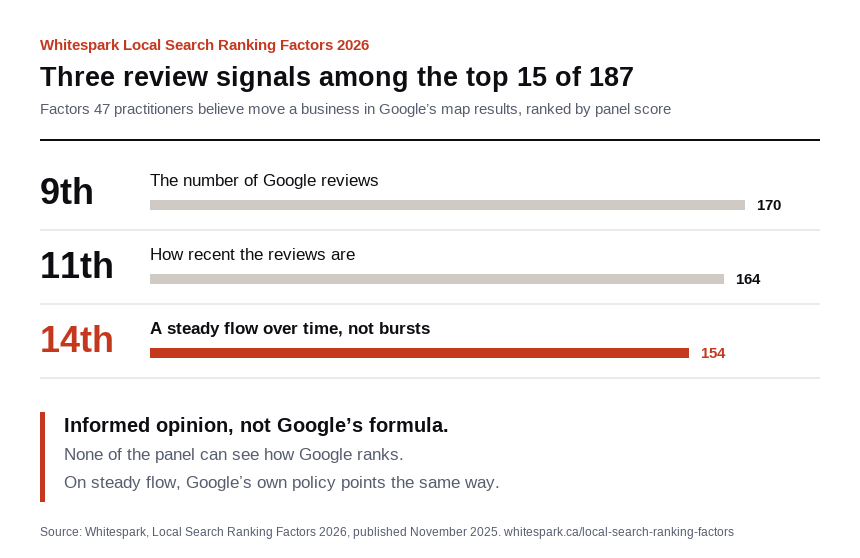
The people who do local search work for a living read the same pattern from the other side. Each year Whitespark asks a panel of local search practitioners to score the factors they believe move a business in Google’s map results. In the 2026 edition, published in November 2025 from 47 of them, the number of Google reviews came ninth, how recent the reviews are came eleventh, and a steady flow of reviews over time, rather than bursts, came fourteenth. The report says plainly that none of the panel can see how Google ranks, so this is informed opinion rather than a rule. On the shape of the flow, though, the two point the same way: the practitioners score a steady flow as a factor in its own right, and Google’s policy treats a sudden burst as a warning sign.
Asking is allowed, and it is most of the method
Google’s own advice for getting more reviews starts with reminding customers to leave one. The forum question began from the same observation: people rarely review even after a good meal. Often nobody asked at a moment when it was easy, and asking costs nothing.
The link and the QR code Google already gives you
There is no need for a paid tool to make a review link. In your Business Profile, select Read reviews, then Get more reviews. Google shows a link to copy and a QR code to download, and both open the review box for your business directly. Google notes that the QR code can only be generated in a computer browser, not on a phone, so making it is a job for a laptop.
If you want the code on a printed sign with a line of text under it, our free QR code generator makes one from the same link.
The sign-in screen before the review box
A customer has to be signed in to a Google Account to leave a review. It does not have to be a Gmail address, and an account can be made with any email. A customer who is not signed in meets a login screen before the review box, which is one more step between a willing customer and the review, and worth knowing when somebody says the link did not work.
Where Google suggests putting it
Google’s help pages suggest four places: on receipts, in thank-you emails, at the end of a chat conversation, and on a printed QR code displayed in the shop. It also mentions sending the request by WhatsApp or in a Facebook post.
For a business that takes its orders in Messenger, the chat is the one that matters. If the order, the booking or the job was agreed there, the end of that same conversation is the natural place for one line of thanks and the link.
When to ask depends on what you sell
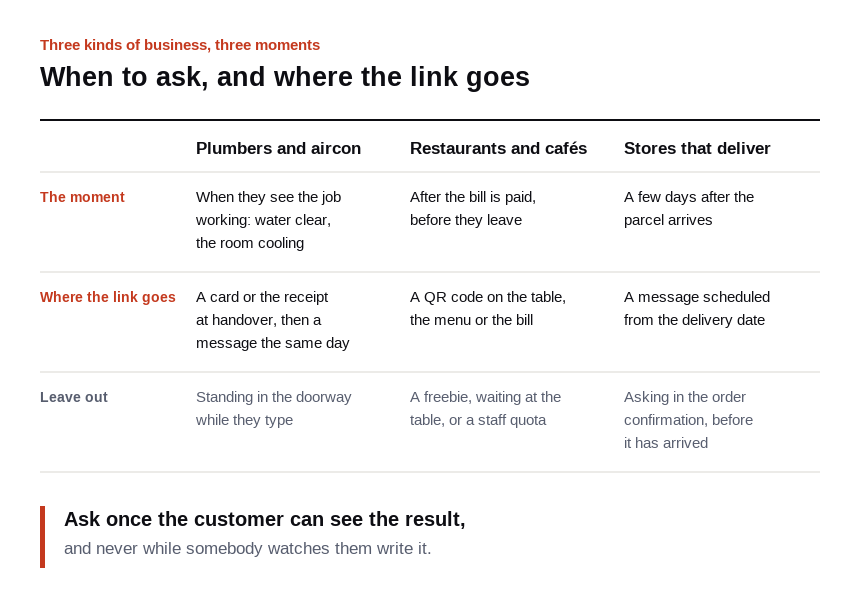
The right moment is the one where the customer can see the result and is not being watched while they decide what to write. That moment falls in a different place for each kind of business.
The trades: at handover, then again the same day
For a plumber or an aircon technician the best moment is when the customer sees the job working: the water running clear, the unit cooling the room. Ask then, in a sentence, and hand over something with the link on it, such as a card or the receipt. Do not stand in the doorway while they type.
Then send the link in a message the same day, while the job is still fresh. The invoice two weeks later arrives when the repair has become an ordinary part of the house rather than a problem that was solved.
Restaurants and cafés: before they leave, without an audience
A meal is over when the bill is paid, so the request belongs before the diner leaves. The QR code on the table, on the menu or on the bill is there while the meal is fresh and does not require anybody to stand beside it.
Staff can mention it. What they cannot do, under the policy, is offer something for it, wait at the table for it, or be set a number of reviews to bring in. The code on the bill with a plain line of thanks is the permitted version, and it asks at the right moment.
Stores that deliver: after the parcel arrives
A request in the order confirmation asks the customer to review a purchase they have not received. Wait until a few days after delivery, when they have used what they bought. The courier records the delivery date, so the message can go out on a schedule rather than whenever somebody remembers.
Google’s guidelines open Business Profiles to businesses customers can visit and to businesses that travel to customers. If you sell only online, with no counter or pickup point a buyer can come to, the review you want is probably on the marketplace or on your own store rather than on Google.
The reply is part of the ask
Google recommends replying to reviews, and its advice on how is short and practical. Keep the reply brief. Say something specific rather than sending the same thank-you to everybody. Do not use the reply to offer deals or promotions.
What to say to a good one
A good reply names the thing the customer praised and adds one detail: the dish, the unit that was fixed, the area you went out to. It shows the next reader that a person read the review, and the reply stays under the review for every later reader to see.
Where the bad ones are handled
A negative review needs a different kind of reply, and whether it can be removed at all is a separate question. Both are covered in our piece on what to do about a bad review, including why a steady flow of genuine reviews is the thing that makes one bad one survivable.
The one change to make first
Which change comes first depends on what is on your counter today.
If you offer something for a review
Take the offer down this week, and keep the QR code. The code on its own, with a plain line such as “Tell us how we did”, is permitted. The offer is the part that puts the listing at risk.
If staff have been given a target, remove the target and keep the habit of mentioning the review, without a number and without asking customers to name anybody.
If you have never asked at all
Copy the link from your profile today and put it in the one place where every customer already passes: the receipt, the invoice, or the last message of the Messenger conversation. Nothing else needs to be in place first. Ask everybody, not only the customers who seem pleased, and the reviews that arrive will be the kind that stay.
Questions we get