

A family restaurant in Manila was close to closing. The people who tried the food liked it, and a good number of them said the same other thing: from the street, the place looked like a house. Nobody walking past could tell it was a restaurant. When the owners finally had money to put towards the problem, the first thing they spent it on was signage and a tarpaulin.
That is the situation most business tarpaulins are bought in, and the print shop’s first question is the size. The usual answer comes from the price list: two by three feet because it is the cheapest, or four by six because it looks generous. What follows is how the size is actually decided, which is by the distance it will be read from, what fits on it once the letters are large enough, the file that survives being printed at full size, and where a business is allowed to hang it.
In short
- The size follows the letters. A published sign standard allows about thirty feet of reading distance for every inch of capital letter height.
- On a well-made sign the words take up about 40 per cent of the face and the rest is left empty.
- Words set entirely in capitals need about 15 per cent more height to be read from the same distance.
- Printers commonly ask for 100 to 150 pixels per inch at the full printed size, or a vector file. A screenshot stretched to four feet is neither.
- In Metro Manila, signs are banned on posts, trees, sidewalks and across roads. Hang it on your own frontage, with the permit your city asks for.
What a tarpaulin has to do from across the street
A tarpaulin on a shopfront is not read the way a menu or a Facebook post is read. Nobody stops in front of it. It is seen from a moving tricycle, from the far side of a road, or over the heads of people on a busy sidewalk, and it has one or two seconds to be understood.
It is read in passing
The United States Sign Council Foundation, which publishes research-based standards for business signs, starts its sizing method from exactly that: a sign’s size is determined by the length of the message and the time needed to read and understand it. A review of research on sign legibility cites findings that a single glance takes in three or four short, familiar words.
So the useful question is which three or four words a stranger has to take away, and how large they must be for that to happen from where the stranger is, rather than how much can be printed on four by six feet.
The three things it has to say
For a business on its own premises, those words answer three questions, in this order:
- What is this place called? The name customers say out loud, not the full registered name.
- What does it sell? In the words a stranger would use: noodles, aircon repair, printing, pharmacy.
- How do I reach it? One way, not five. A phone number, a QR code or the name of the Facebook page, chosen for how your customers actually contact you.
A name on its own does not say restaurant. For a shopfront that looks like a house, the second line is the one doing the work.
The size follows the letters, and the letters follow the distance
The arithmetic
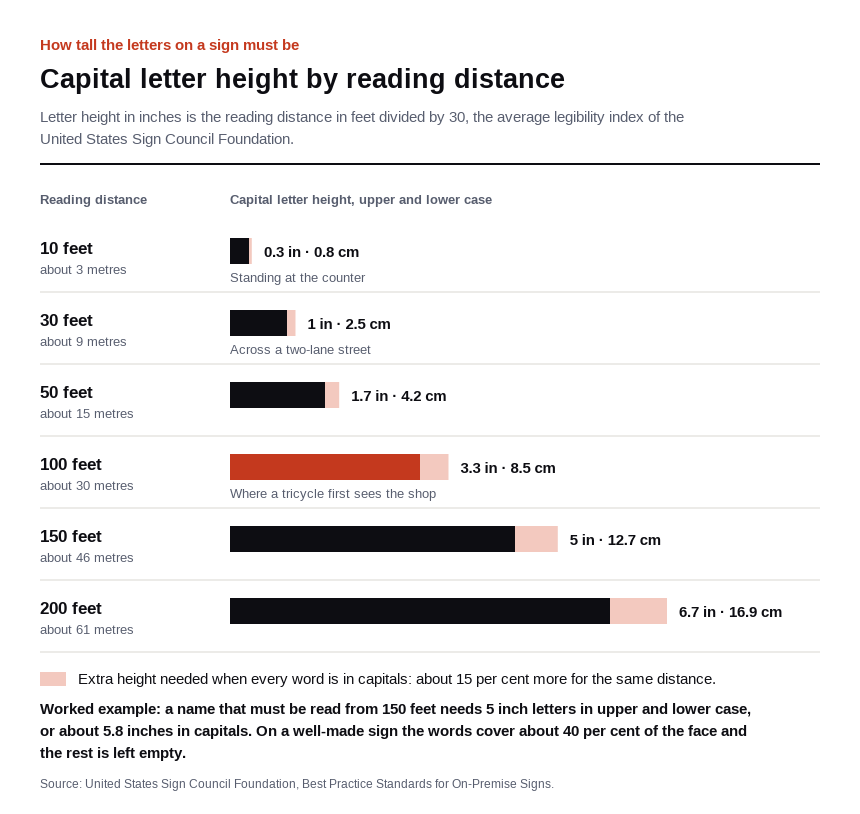
The foundation’s method turns distance into letter height with one division. Its standard legibility index is a number of feet of reading distance for every inch of capital letter height, and it gives 30 as the average to use when the exact lighting and colours are not yet known. Letter height in inches is the reading distance in feet divided by 30.
Worked through for a shop:
- From the far side of an ordinary two-lane street, roughly thirty feet or nine metres away, capital letters need to be about one inch tall. That is enough for somebody on the opposite sidewalk.
- From a hundred feet, or about thirty metres, where a tricycle or a car first sees the shop, they need about three and a third inches.
- From a hundred and fifty feet, about forty-six metres, they need five inches.
Set the business name at the height your furthest customer needs, then let everything else be smaller. The name is the one thing that has to be read from the corner.
All capitals cost you size
The same standard notes that words set entirely in capital letters need about 15 per cent more letter height to be read from the same distance as words in upper and lower case. A tarpaulin that shouts every word in capitals is using a larger sheet to say the same thing, or saying it less clearly on the sheet it has.
Capitals are fine for a short name. For anything longer, upper and lower case is read further away for the same money.
Then choose from the sizes printers quote
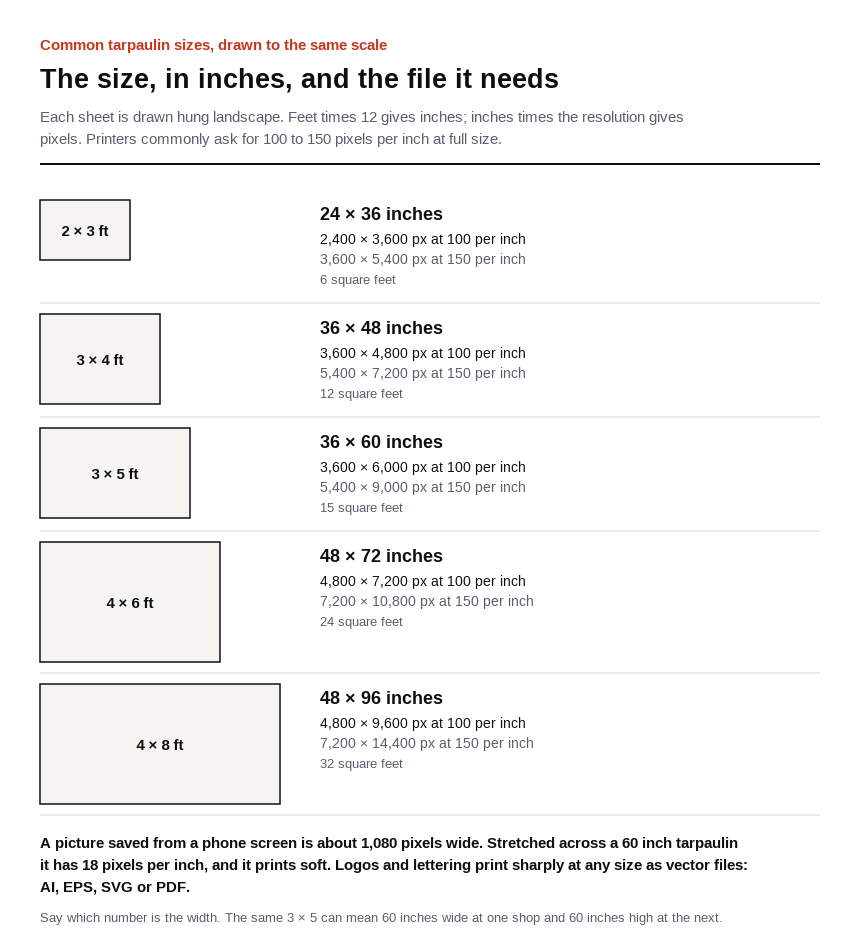
Print shops here quote a short list of sizes in feet and price them by the square foot, so the size question is really a question of which of these gives the name the height it needs. The sizes they quote most often, in inches, are:
- 2 by 3 feet: 24 by 36 inches.
- 3 by 4 feet: 36 by 48 inches.
- 3 by 5 feet: 36 by 60 inches.
- 4 by 6 feet: 48 by 72 inches.
- 4 by 8 feet: 48 by 96 inches.
Say which number is the width. A three by five hung across a shopfront and a three by five hung down the side of a doorway are different layouts, and the first number means width at one shop and height at the next. Writing it as 60 inches wide by 36 inches high removes the argument before it starts.
What fits once the letters are big enough
Leave most of it empty
The foundation’s worked example of a well-proportioned sign has the words covering 40 per cent of the panel and the remaining 60 per cent left as empty space around them. That white space is not wasted. It is what lets the eye find the words at a distance, and it is the part that gets filled first when a layout is done in a hurry.
A tarpaulin designed the usual way does the opposite: a photograph behind everything, a list of products with prices, two phone numbers and every social account. Each extra item makes the name smaller, and the name is the only part anybody on the road will try to read. The detail belongs on the menu, a counter sign or a website, which people read while standing still.
The name people say
Print the name customers use when they recommend you, which is often shorter than the one on the registration certificate. Why the two differ, and which belongs where, is covered in the name on your certificate is not the name on your sign.
If the name is in a language other than English or Filipino, the rules on signs in the implementing rules of the National Building Code ask for a corresponding translation in English or in the local dialect. For a Chinese or Korean restaurant, that line is also the one that tells passers-by what the place is.
What you sell, in the words a stranger uses
This is the line most often missing. A name is only informative to people who already know it. One or two words underneath, in the language a stranger would type into a search, turn a name into a shop: noodles and rice meals, aircon cleaning, pharmacy.
One way to reach you, not five
Choose the channel customers actually use and print that one large enough to be read. A phone number at the same size as the rest of the fine print cannot be read from the road, and it will not be written down from a jeepney.
A QR code works only for somebody standing close. The working rule on our QR code generator is one centimetre of code for every ten centimetres of distance, so a code on a tarpaulin read from three metres away needs to be about thirty centimetres across. If it cannot be that large, it belongs on the counter rather than above the door.
The file that survives being printed large
Pixels at the full size
A printer needs to know how many pixels the file has at the size it will be printed. The sum is simple: feet times 12 gives inches, and inches times the resolution gives pixels. Large format printers commonly ask for 100 to 150 pixels per inch at full size, well below the 300 used for brochures, because a tarpaulin is read from metres away rather than held in the hand.
So a 3 by 5 foot tarpaulin, 36 by 60 inches, wants a file of about 3,600 by 6,000 pixels at 100 pixels per inch. A picture saved from a phone screen, around 1,080 pixels wide, stretched across the same 60 inches gives 18 pixels to the inch. It will print, and it will look soft from the sidewalk. The shape matters as well: a portrait phone picture on a wide tarpaulin is cropped or stretched, which is the problem aspect ratio describes.
The logo should be a vector file
A logo taken from a Facebook profile picture is a few hundred pixels across, and no amount of enlarging adds detail that was never there. Printers ask for the logo as a vector file, usually AI, EPS, SVG or PDF, because it is stored as shapes and prints sharply at any size. If whoever designed your logo only ever sent a PNG, ask for the source file before the next sign is due, not the afternoon it is due.
Colours move between screen and vinyl
Screens mix light and printers mix ink, so a colour chosen on a phone rarely comes back identical on a tarpaulin. If the colour is part of how customers recognise you, send the printer the colour codes in both forms, explained under CMYK, and ask to see a small proof before the full sheet is printed.
The layout fee at the counter
Many print shops offer the design itself as a small add-on to the print, listed beside the price as with or without layout. For a birthday greeting that is reasonable. For the sign that will represent the business for a year, it means the most visible piece of marketing the business owns is laid out at the counter, by somebody who may never have seen the street it will hang on.
If the layout is done at the counter, go in with the three lines of text decided, the logo as a vector file and the reading distance measured. That turns a quick layout into a correct one.
Where it is allowed to hang
On your own frontage
The National Building Code’s chapter on signs is short. A sign must not confuse or block the view of any official traffic sign, must not obstruct the view of the public so as to become a traffic hazard, and must be kept in repair, neatly painted and secured at all times. A tarpaulin tied to the shop’s own frame, above its own entrance, sits comfortably inside those lines.
Not on posts, trees or the sidewalk
In Metro Manila the limits are written down plainly. A Metro Manila Council regulation on billboards and advertising signs prohibits private commercial signs and streamers installed over, across or along public roads, centre islands and road rights of way. The anti-littering rule it reinforces makes it unlawful to post signs on any part of the roads, sidewalks, centre islands, posts, trees and open spaces.
Fines under that regulation are charged by the square foot of the sign, so a larger tarpaulin in the wrong place costs more, and a second offence carries a far larger fixed fine. Outside Metro Manila the equivalent rules are set by each city or municipality.
The sign permit
In Metro Manila, the regulation gives the city or municipal mayor the authority to issue permits for signs along local roads and on private property. Owners in Manila describe paying for a sign permit on top of the business permit, and in one case a further registration charge for the same sign. The requirements and fees differ from one city to the next, so the business permits office is the place to ask, before the tarpaulin is printed rather than after it is up.
When a tarpaulin stops being the answer
It fades, and a faded sign says something
A tarpaulin in full sun does not look the same after a year. The building code’s requirement that signs be kept neatly painted and secured is a legal duty, but it is also a signal to customers: a faded, sagging sign reads as a business that has stopped paying attention, or has closed.
Temporary by design
A tarpaulin is the right choice for an opening, a promotion, a new branch, or the months while a permanent sign is being made. Once the location is settled and the name is not going to change, a permanent sign built from the same vector logo is usually the better investment, and the tarpaulin goes back to announcing things.
The sign and the listing should agree
Google asks that the name on a Business Profile be the name the business uses in the real world, consistently on its storefront and branding. The tarpaulin is often the storefront. Whatever name it carries is the name customers will search for later, which is why it is worth getting right before it is printed. The name field is also one of the Google Business Profile fields businesses here most often get wrong.
Before you pay for any size
Print the business name on ordinary paper at the letter height you intend, tape it where the tarpaulin will hang, and walk to the spot where your customers first see the shop. If you cannot read it from there, no layout will fix it, and the size on the order is wrong.
Questions we get