

Somebody messages your page, asks whether an item is on hand, and you answer within a few minutes. Then nothing. No reply, no order, no explanation. Most owners file that under price, or under a buyer who changed their mind.
Sometimes something else happened in between: the buyer went to check whether you are real. Search data for the Philippines lists close to two hundred variations of “is [name] legit”, each typed somewhere between ten and thirty times a month, alongside general questions about how to spot a fake seller.
What follows is what the general version of that search returns, what it teaches the buyer to look for, and where a shop’s own website fits into a check that is mostly written by other people.
In short
- We ran five general searches of the kind a worried buyer types and read the top five results on each. All twenty-five were third-party pages. None was an online shop’s own website.
- Facebook and Reddit posts took ten of those twenty-five places. The advice a buyer absorbs is mostly a conversation between strangers.
- The legal explainers among those results tell the buyer to match the payment account name to the seller, check how old the page is, and search the business name register.
- A shop’s own site will not rank for the general question. It can rank for its own name: for the two well-known stores we tested, it did.
- A search that turns up nothing about you is not a neutral result. It reads as a shop with no history.
The question being asked about you is not only about your product
A first-time buyer has limited ways to judge whether your goods are good. They have photographs, which can be copied, a price, which proves nothing, and a page that looks much like other pages. So a large part of the check is about something else: whether you will still be there after they have paid.
What the check is actually for
The advice pages a buyer reads keep returning to one risk: paying and receiving nothing, with nobody to pursue. The questions that follow are pointed at that. Who are you, where are you, and what happens if this goes wrong.
That changes what your page is being read for. The product photograph is part of the picture. What the advice pages add is anything suggesting you can be identified and found again, which many small shops have never published.
Why the suspicion is rational
It is easy to treat this as an insult. It is closer to ordinary behaviour in a market where nearly everybody has been targeted. In TransUnion’s fraud survey of consumers across eighteen countries at the end of 2024, seventy-four per cent of Filipinos said they had been the target of an online, email, phone or text fraud attempt in the previous three months, against fifty-three per cent across all the markets surveyed.
A buyer who checks you is not singling you out. They would run the same check on any shop they had not bought from before.
What the general search returns
Rather than assume what a worried buyer finds, we ran five of the general searches they type, among them “how to know if online shop is legit philippines”, “is this online seller legit facebook philippines” and “scammer online shopping philippines”, and read the first five organic results on each.
One of the five, the short “is shop legit”, Google read as a question about a single shopping app of that name. That is a small lesson of its own: a short or generic name is easily mistaken for something else.
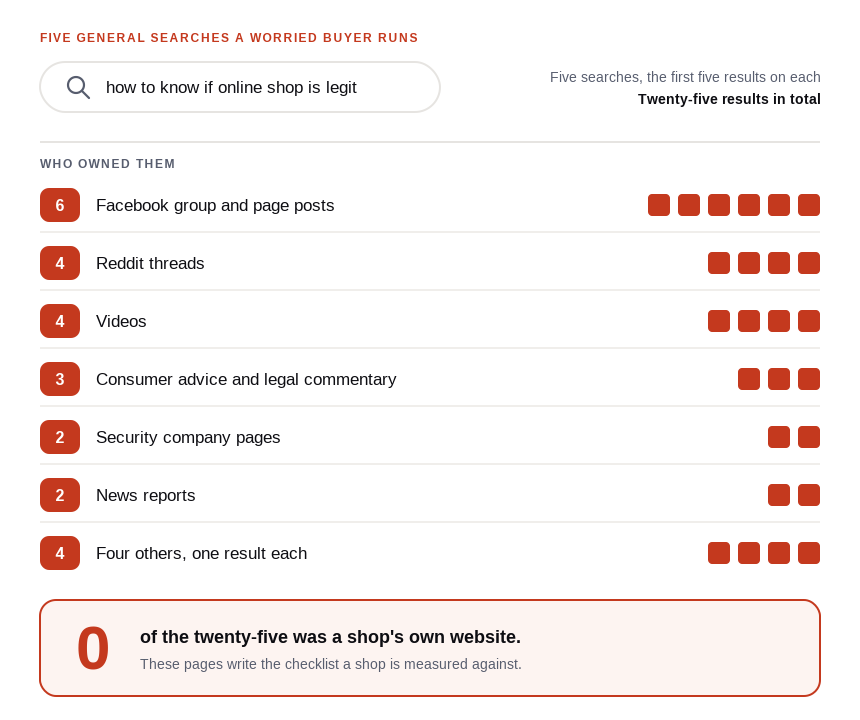
Twenty-five results, and who owned them
- Facebook group and page posts took six places, among them a post warning about Facebook Marketplace and a police station’s own advisory.
- Reddit took four, from scam-reporting and Philippine communities, including one thread titled in Cebuano.
- Videos took four.
- Legal explainers took three, all from one Philippine law firm’s commentary pages, on how to verify a seller and how to complain after being scammed.
- Security companies took two, one of them offering an automated shop checker.
- News reports took two, national newspaper coverage of a police warning and of survey findings about the scale of online shopping scams.
- The remaining four were a review platform, a personal blog, a beauty and lifestyle magazine and a leaflet from the central bank.
Why no shop appeared, and why that still matters
No shop’s own website appeared in any of the twenty-five. For a general question that is not surprising: a shop has no reason to rank for “how to spot a scam”, and a page in which a shop vouches for itself would carry no weight if it did.
It matters because of what these pages do instead. They write the checklist. By the time a buyer is looking at your page, they may already have read a list of things a real seller has and a fake one lacks, written by people with no commercial interest in the answer.
Who writes the checklist
Posts and threads
Ten of the twenty-five results were Facebook or Reddit posts, which makes conversation the largest single component of what the buyer reads. These are also the only kind of page in the list that can mention a particular shop by name. A security company’s guide is generic. A thread in which somebody asks whether anybody has bought from a given seller is a page about that business that the business did not write and cannot edit.
The legal and consumer explainers
The three law firm pages, the security company guides and the lifestyle magazine’s shopping guide are where the checklist is spelled out most fully. Their effect is less about any one shop and more about what the buyer is taught to look for.
The news reports and official warnings
Police advisories, newspaper coverage and a central bank leaflet made up the rest. Their effect is on the buyer’s starting point, and the starting point is suspicion.
What buyers are told to verify
We read four of the advice pages in full: the two law firm pages on checking a seller, the security company guide and the Shopee and Lazada shopping guide. The items below are what they ask of a seller. They ask about the goods as well, but the checks on the seller are the ones a shop can prepare for in advance.
Whether you can be identified and located
The longer law firm guide asks for a business name, a traceable address or at least a consistent place of operation, and working contact details, and it tells the buyer to compare these across every platform where the seller appears. The security company guide also looks for a physical address. Both law firm pages tell the buyer to check how old the page or account is and whether it has been renamed, and the longer one treats comments that are disabled or restricted as a warning sign.
The name on the payment account
Both law firm pages tell the buyer to compare the name on the receiving account, whether a bank or a wallet, with the seller’s name before sending money. The longer one calls an inconsistency a red flag. The security guide and the shopping guide do not mention it.
There are ordinary reasons for a mismatch, and small sellers using a personal wallet are not doing anything wrong. The problem is that a buyer who has read those pages has been told to treat it as a warning, and you will not be there to explain. If the name you collect money under is different from the name you sell under, it is one of the few items on the list you can simply fix.
The register anybody can search
Both law firm pages point the buyer to the Department of Trade and Industry, which runs a public Business Name Search on its registration portal. The name you trade under either returns a record or does not.
This is where the gap between a registered name and a trading name stops being an administrative detail. If you registered one thing and painted another on the sign, the buyer who checks finds nothing, and an empty result looks the same whether the cause is fraud or a naming decision made three years ago. We have written separately about which name belongs on the sign; the register search is the moment that decision gets tested by somebody who will not ask.
Whether a return is possible
The longer law firm guide tells the buyer to settle warranty and return terms before paying, including who pays for return shipping. The security guide says to read the return and warranty fine print. The shopping guide points to the platforms’ own buyer protection. A shop that states its return position in public has answered one item on the list before it is asked.
The search with your name in it
The general search teaches the checklist. The search that applies it to you is the one with your name in it, and that is a different results page.
What we found for two established stores
We ran that search for two well-known Philippine online stores. For Lazada, the store’s own site took the first two positions. For Zalora, a page on the store’s own site came fourth, below a Reddit thread, a review platform and a video. In both cases the store’s own domain was on the first page, next to what other people had said about it.
We did not test small shops, and the result will vary with how much of a shop exists online. What the two cases show is narrower and still useful: the named search is one where a shop’s own site can appear, which the general search is not.
Where the site decides the outcome anyway
Even when it ranks, a shop’s own site is not persuasive because it says the shop is real. It is persuasive when it agrees with everything else. A buyer who has read a thread, been given a payment account name and seen a delivery quote is holding several loose facts. A site on your own domain is one place where those can be confirmed as belonging to the same business, or shown not to.
That is a narrower job than most owners imagine, and a more important one. It is also a different case for a website than the usual argument about whether a Facebook page is enough.
Silence is a verdict too
An awkward outcome of the check is not a bad thread. It is nothing at all.
What an empty result reads like
The advice pages tell the buyer to look for reviews, tagged posts from customers and a history of transactions. A buyer who finds none of that has learned that you have no public history. To somebody about to send money to a stranger, no history and a bad history are not as far apart as they should be.
What fills the silence
Very little of what you publish about yourself fills it, because the checklist asks for evidence from other people. What fills it is reviews carrying your name, customers who posted about an order, a listing on a platform that shows completed transactions, a thread in which somebody vouched for you.
None of that is a campaign. It is the record left by having sold things to people who were willing to say so in public, which is why new shops feel this most and why it tends to ease as orders accumulate.
The moment this becomes your problem
For many Philippine sellers this is somebody else’s problem, right up until the day it is not, and the day it changes is predictable.
While the platform is answering for you
A marketplace does much of the reassuring on your behalf. It holds the money, shows a rating, records how many orders you have completed and gives the buyer a route to a refund. The shopping guide in our results tells buyers to check exactly those things, inside the app, and never to pay outside it.
That is a real service and it is worth what it costs. It also means the verification problem stays invisible to you for as long as it lasts, because you have never had to pass the check yourself.
When you ask to be paid directly
The platform’s protections stop the moment the transaction leaves it. A direct message, a bank transfer, a wallet number, your own store: each of these hands the buyer back the whole checklist, at the point after they have decided they want the item and before they have paid.
Many sellers reach this eventually, because the margin is better and the customer becomes yours rather than the platform’s. The check arrives with that decision, not gradually, and it arrives whether or not you have prepared for it.
What that means for the next sale
You will not see it happen. A buyer who checks does not announce it and does not come back to report what they found, so the cost shows up as unexplained silence rather than as an objection you could answer.
So the question is not whether to care about any of this. It is whether the person who checks you tonight finds one business or several, and that is settled by your name, your payment details and your own domain agreeing with each other long before anybody searches.
Questions we get